
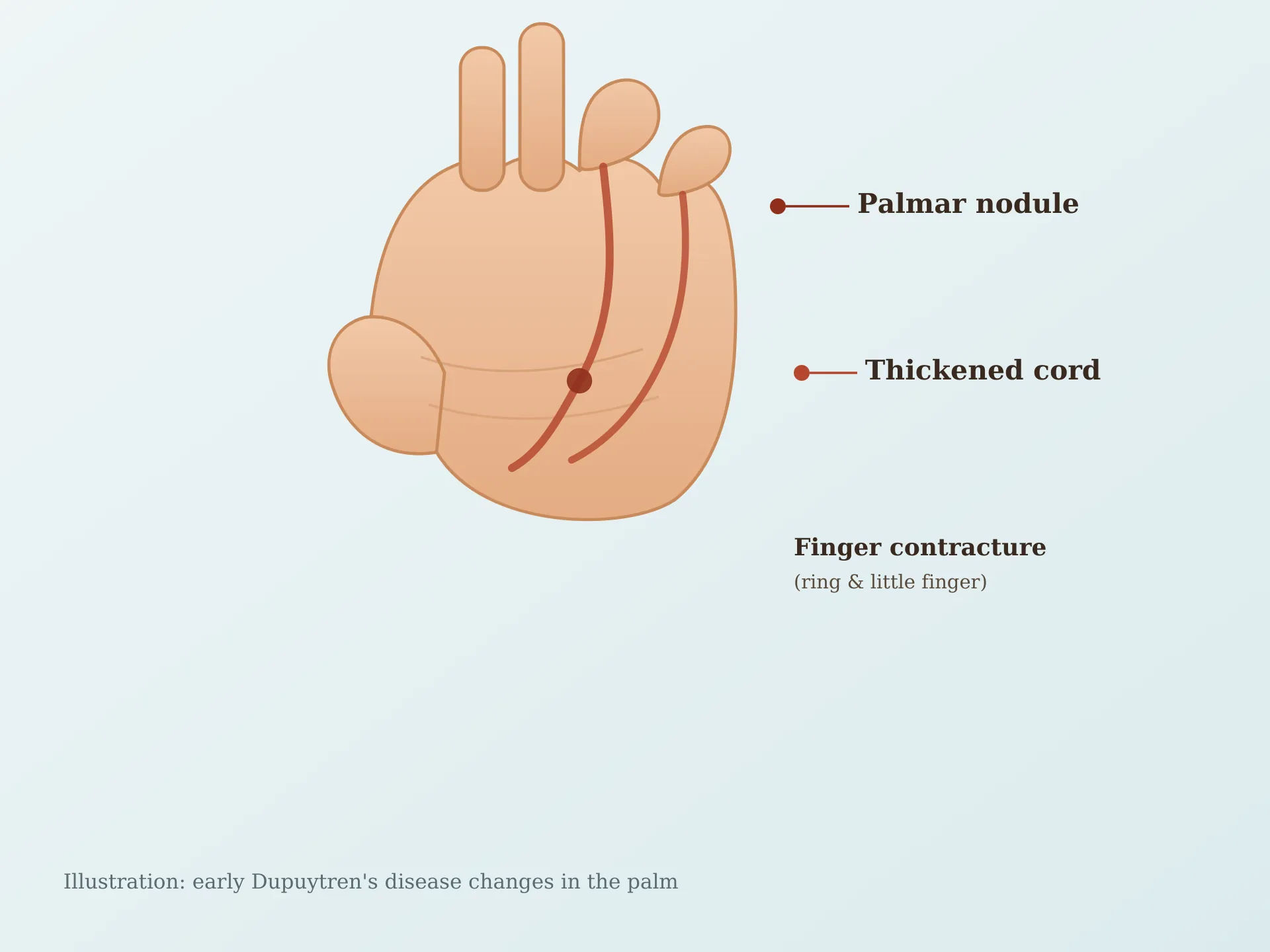
Dupuytren’s disease may start with a seemingly harmless thing such as a small lump, a shallow depression, or a feeling of tightness in the palm. Over time, the tissue under the skin can thicken and form cords that pull one or more fingers toward the palm.
For some, the disease remains mild. In other people it is more aggressive, or it returns after treatment. This is where the term “Dupuytren’s diathesis” occurs.
Dupuytren’s disease is a pattern of clinical features that is associated with a greater tendency for progression, extension, or recurrence of disease. Research has linked recurrence to features such as younger age at onset, bilateral disease, family history, and disease outside the palm, but newer systematic reviews suggest that the strength of evidence for individual diathesis factors is not always consistent.
This guide explains what Dupuytren’s diathesis is, how it relates to common Dupuytren problems, what symptoms to look out for and what treatment options may be considered.
What Is Dupuytren’s Diathesis?
Dupuytren’s diathesis is not a separate disease. It is a term used to describe certain characteristics that may indicate a more active or recurrent form of Dupuytren disease.
Dupuytren disease affects the connective tissue, or fascia, beneath the skin of the palm and fingers. As this tissue becomes abnormally thickened, nodules and cords can develop. Eventually, these cords may prevent the affected fingers from fully straightening.
Historically, researchers identified several characteristics associated with what was called a “diathesis.” These included:
- A family history of Dupuytren disease
- Disease affecting both hands
- Younger age when symptoms begin
- Disease occurring outside the palm
- Knuckle pads, also called Garrod’s pads
- Plantar fibromatosis, commonly called Ledderhose disease
- In some studies, male sex and involvement of multiple fingers
A 2006 study proposed an updated group of diathesis factors, including family history, bilateral disease, ectopic lesions such as Garrod’s pads, male sex, and onset before age 50.
However, these factors should not be treated as a precise prediction for an individual patient. A later systematic review found that evidence for some traditional diathesis factors is inconsistent and that the quality and generalizability of studies vary.
Is Dupuytren’s diathesis the same as severe Dupuytren disease?
Not necessarily.
A person may have several features associated with Dupuytren’s diathesis but relatively limited contracture. Conversely, someone without several classic risk factors can still develop significant finger contractures.
The term is most useful as part of a broader clinical assessment rather than as a diagnosis by itself.
Common Dupuytren Problems and Warning Signs
The earliest symptoms of Dupuytren disease can be easy to overlook.
The condition commonly begins with changes in the palm rather than an immediately bent finger. You might notice a firm lump, a ridge beneath the skin, or puckering of the skin. Over months or years, the tissue may develop into a cord that gradually restricts finger movement.
Common Dupuytren problems include:
1. Firm lumps in the palm
A small, hard nodule may develop beneath the skin. It can initially cause little or no functional difficulty.
2. Skin puckering or dimpling
The skin over the affected area may become pulled inward as the underlying tissue changes.
3. Thickened cords
A cord-like structure can develop along the palm and toward a finger.
4. Difficulty straightening a finger
This is one of the most important signs of progression. A finger may gradually become fixed in a bent position.
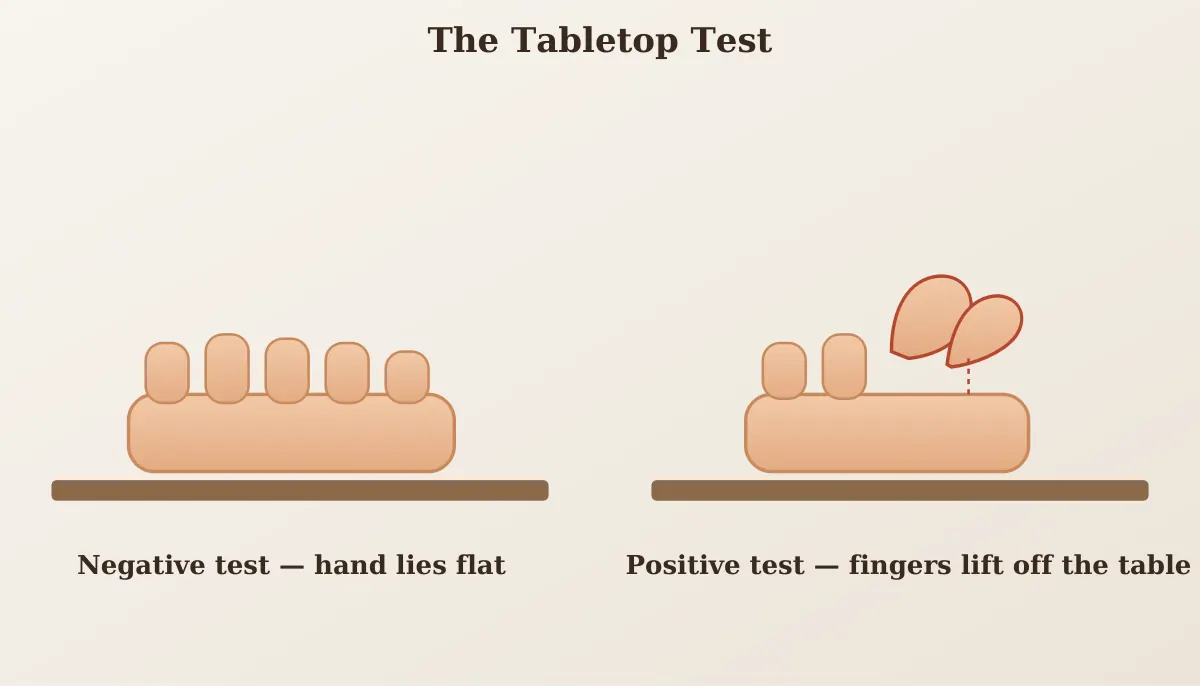
5. Problems placing the hand flat
A simple “tabletop test” can sometimes reveal functional limitation: if you cannot comfortably place your palm and fingers flat on a table, discuss the finding with a healthcare professional.
6. Difficulty with everyday activities
Progressive contracture can interfere with tasks such as putting a hand into a pocket, wearing gloves, shaking hands, gripping objects, or placing the hand flat on a surface.
Dupuytren disease often affects the ring and little fingers and may affect both hands. It typically progresses slowly, although the rate varies substantially from person to person.
What Causes Dupuytren’s Diathesis?
There is no single confirmed cause of Dupuytren disease.
Genetic susceptibility appears to play a major role. A review of the condition describes Dupuytren disease as a complex disorder involving genetic and environmental factors. Family history is one of the better-established associations.
Family history
Dupuytren disease can run in families. Having close relatives with the condition may increase the likelihood of developing it and may be relevant when assessing recurrence risk.
Age at onset
Developing Dupuytren disease at a younger age, particularly before 50, has traditionally been considered a diathesis feature. Several studies have associated younger onset with recurrence or more extensive disease.
Bilateral disease
When both hands are affected, this is another feature historically associated with Dupuytren’s diathesis.
Disease outside the palm
Some people develop fibrous changes elsewhere in the body. Examples include:
- Ledderhose disease, affecting the tissue on the sole of the foot
- Peyronie’s disease, involving fibrous tissue of the penis
- Garrod’s pads, which appear as thickened areas over the knuckles
These associated conditions can be relevant when a specialist assesses the overall pattern of disease.
Lifestyle and other associations
Research has also identified associations between Dupuytren disease and factors including diabetes, smoking, heavy alcohol consumption, and manual work. However, these factors should not be interpreted as proof that a particular person’s disease was caused by one of them. Evidence for some non-genetic factors is variable.
How Is Dupuytren’s Diathesis Evaluated?
There is no single blood test that confirms Dupuytren’s diathesis.
A clinician generally considers the patient’s history and examines the hands. Important information may include:
- Age when symptoms first appeared
- Whether one or both hands are affected
- Which fingers are involved
- Degree of finger contracture
- Family history
- Presence of nodules, cords, or knuckle pads
- History of plantar fibromatosis or other related fibrotic conditions
- Previous Dupuytren treatment
- Whether the disease has returned after treatment
This information helps distinguish stable, early disease from a pattern that may require closer observation or more active treatment.
Importantly, older studies proposed specific combinations of risk factors to estimate recurrence. More recent systematic evidence suggests that traditional diathesis factors can be associated with development and recurrence, but they do not reliably predict poor functional outcomes after every intervention.
Treatment Options for Dupuytren Problems
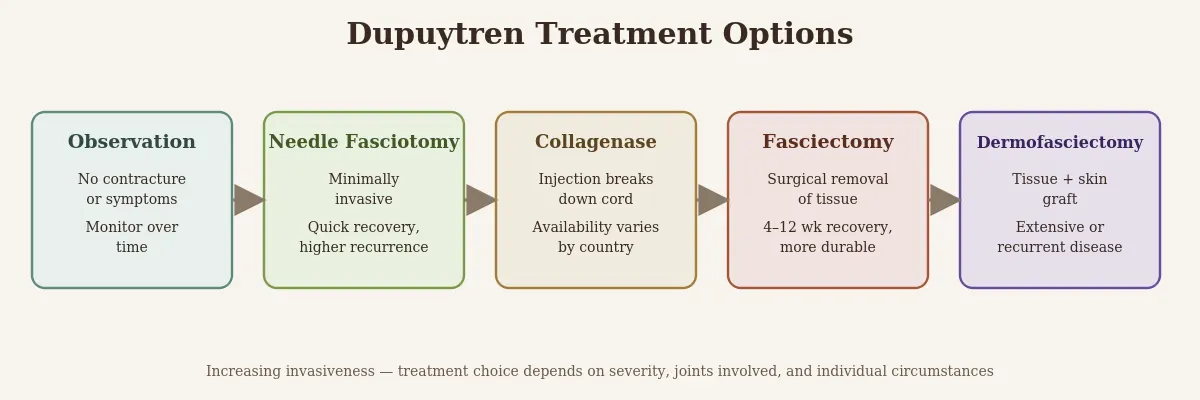
Treatment depends on the severity of contracture, symptoms, functional limitations, the joints involved, previous treatment, and individual circumstances.
Early Dupuytren disease often does not require immediate intervention. If the fingers become significantly contracted or hand function is affected, a specialist may discuss treatment options.
Observation and monitoring
If there is a nodule without significant contracture or functional impairment, monitoring may be appropriate.
Regular assessment can help identify whether the disease is changing. A healthcare professional may measure finger extension and monitor the ability to perform everyday activities.
Needle fasciotomy
Needle fasciotomy, also known as needle aponeurotomy, uses a needle to divide restrictive cords so that the finger can be straightened.
Its advantages can include a relatively quick recovery and less invasive treatment. However, recurrence can occur, and the procedure is not suitable for every pattern of disease.
Collagenase injection
Collagenase injections have been used to weaken and break down Dupuytren cords in selected patients.
Availability and clinical use vary by country and over time, so patients should discuss whether this option is appropriate and available with a hand specialist.
Fasciectomy
A fasciectomy involves surgically removing affected fibrous tissue.
It can provide more durable correction than some less-invasive approaches, but it is a surgical procedure with a longer recovery period and potential complications such as stiffness, numbness, bleeding, infection, or injury to nearby structures. NHS guidance reports a typical recovery period of approximately 4–12 weeks after fasciectomy.
Dermofasciectomy
For selected cases, particularly extensive or recurrent disease, a surgeon may remove affected tissue along with overlying skin and use a skin graft.
This is a more extensive procedure and generally requires a longer recovery.
Does treatment permanently cure Dupuytren disease?
Not necessarily.
Current treatments primarily address contracture and affected tissue rather than eliminating the underlying tendency to develop Dupuytren disease. Recurrence or development of disease in another area can occur after treatment.
A 2026 systematic review of prospective studies found recurrence after treatment remained common over an average follow-up of 3.8 years, with recurrence varying according to treatment type and joint involved. The authors also found that proximal interphalangeal (PIP) joint contractures were more likely to recur than metacarpophalangeal (MCP) contractures.
When Should You See a Specialist?
Consider seeking medical assessment if:
- A lump or cord is developing in your palm.
- A finger is becoming progressively bent.
- You cannot place your hand flat on a table.
- Hand movement is interfering with work or daily activities.
- You have previously been treated and notice a new or returning contracture.
- You have a strong family history and are developing new hand changes.
Early evaluation does not necessarily mean that you need surgery. In many cases, the purpose is to establish a baseline and determine whether the condition is stable or progressing.
If a finger is already significantly contracted, delaying assessment may make later correction more difficult.
Frequently Asked Questions About Dupuytren’s Diathesis
What does Dupuytren’s diathesis mean?
Dupuytren’s diathesis refers to a pattern of clinical characteristics associated with a greater tendency toward Dupuytren disease progression, extension, or recurrence. Commonly discussed features include younger age at onset, bilateral disease, family history, and ectopic fibromatosis.
Is Dupuytren’s diathesis hereditary?
Genetic factors have an important role in Dupuytren disease, and family history is a recognized risk factor. However, inheritance is complex, and having an affected relative does not mean that a person will necessarily develop severe disease.
Can Dupuytren’s disease come back after treatment?
Yes. Recurrence is possible after treatment because procedures generally correct the contracture or remove affected tissue rather than eliminating the underlying disease tendency. Recurrence rates vary considerably depending on the treatment, follow-up period, disease characteristics, and definition used.
Does Dupuytren disease always require surgery?
No. Early disease without significant contracture or functional impairment may simply be monitored. Treatment is generally considered when contracture or loss of hand function becomes clinically significant.
Which fingers are most commonly affected?
The ring and little fingers are commonly affected. Dupuytren disease can also involve other fingers and may occur in both hands.
Conclusion: Understanding Your Dupuytren Problems
Dupuytren’s diathesis can provide useful context when assessing Dupuytren disease, particularly when considering the possibility of recurrence or more extensive involvement. Features such as younger onset, bilateral disease, family history, and ectopic fibromatosis have been associated with recurrence in clinical research, but they are not a guarantee that the disease will follow a particular course.
The most important step is to pay attention to changes in hand function. A small lump may remain harmless for years, while progressive cord formation can eventually limit finger movement.
If you notice increasing difficulty straightening a finger, placing your hand flat, or performing everyday tasks, arrange an assessment with a qualified healthcare professional or hand specialist. An appropriate evaluation can help determine whether observation, therapy, injection-based treatment, needle procedures, or surgery should be considered.